skip to main | skip to sidebar

mountain bike news

Benefits of Using Bar End on MTB

Bar Ends, is one of complementary accessories that are used in bicycles MTB or Hybrid using Flatbar. ZS previous articles about cycling ditanjakan Tips, bar ends had little discussed.

Nothing wrong with us to understand more deeply, the advantages and disadvantages of the use of bar ends on a bike, especially MTB and Hybrid Hard Bike Trail.


Bar ends is one component of complement in cycling, is an extension that is attached tip wheel bicycle handlebars. In general in the MTB bar ends mounted Hardtrail and Hybrid. The riders use bar ends aim to give a variation type peganggan when driving and can mengatuh body position when riding.

Bar ends may also improve the comfort for the rider as a neutral hand position (palms inward). A comfortable hand position gives more effect on muscle tension hand when riding.
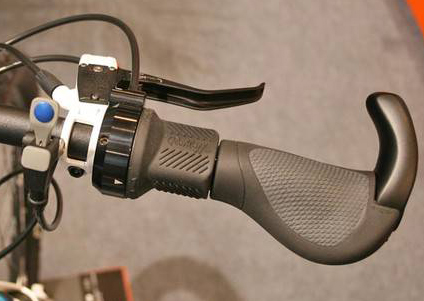

Already include some bar ends with handlebar steering alias welded into one with the handlebar or become one with handlegrip. Bar ends became popular in the early 1990s, began to be abandoned when the end of the 1990s. In some cases, complicate Bar ends when the rider crossed the winding terrain, the use of bar ends are too long can also interfere with comfort when passing on the field of cross-country a lot of trees.

The use of bar ends as well gives a negative effect when braking suddenly, because the rider must memidah hand position so the bike does not stop immediately.

The following advantages and disadvantages of the use of bar ends.
Pros:
- Providing riding comfort ditanjakan
- Allow the body to breathe more comfortably, because the upper body is open.
- Some models Bar ends can protect your hands when it fell (normal hand position).
- Helps prevent fatigue (fatigue) by offering more variety of hand positions.
- A little help increase speed, because the rider becomes more bent position.

Disadvantages:
- Add weight of the bike, because of the additional components.
- If using Flatbar made ​​from Carbon, the risk of fracture is very large steering handlebars.
- The bar ends are more outstanding consuming approximately 1inch handlebar, the rider if you have broad shoulders of course the use of bar ends slightly disturbing comfort.
- Increased risk of injury when a crash, the hands on the bar ends.


Bar ends installation tips:
There is no fixed rule regarding the angle of the bar ends, we can start it from an angle of 45 degrees. If it is the hand position too forward or too backward arrange appropriate convenience when ridding.
   

Bar ends a long and attached too backward to make the bike look less attractive and increase the risk of a fall.
Use the bar ends are in accordance with a curve egronomis grasp hands, bar ends that egronomis provide more comfort when touring long distances.


If pockets of excess does not hurt to use bar ends made ​​of carbon (reducing the weight of the bike) or that include handlebar grip with bar ends.

   
Read More... »»  

Cycling history of Indonesia

Cycling actually has quite long been known in Indonesia, even long before World War II there have been several cyclists are financed by the employers: such as Tropical company, Triumph, Hima, Mansonia and others. They can be categorized as a professional cyclist. Though the time was still the Dutch colonial era. Indeed, the development of sport Cycling quite profitable.
time, particularly the city of Semarang became the center of Cycling. By the architect Van Leuwen Ooiman and founded a Velodrome. Velodromen in Dutch called Wielerband, or "Pias" in Indonesian.In the Japanese era arguably Cycling activities ceased. Only when independence was proclaimed, Cycling fans again tried to popularize. Although not yet organized in a single container, but in individual sports activities seem Sepda Racing grown back. As an example shown when PON II/1951 berlangusng in Jakarta, Racing Bikes diperlombakan including sport.Sport Bike Association of Indonesia or abbreviated new ISSI was founded precisely on the anniversary of National Awakening on May 20, 1956 in the city of Semarang. Before that in 1951, some areas have Cycling associations, such as Yogyakarta, Solo, Surabaya, Semarang, Jakarta, Medan, Manado and Jakarta. Formed Cycling associations, namely:
- ISSS : Ikatan Sport Sepeda Semarang
- PBSD : Persatuan Balap Sepeda Djakarta
- ISSJ : Ikatan Sport Sepeda Jogjakarta
- IPSS : Ikatan Pembalap Sepeda Solo
- PSBS : Perkumpulan Sepeda Balap Surabaya
- PBMS : Perkumpulan Balap Sepeda Medan dan Sekitarnya
- Super Jet : Perkumpulan Balap Sepeda dari Bandung
- PSBM : Perkumpulan Sepeda Balap Manado.
Central Java from the beginning it became the center of bicycle racing sport in the country, especially in the city of Semarang with Sport Bike Association of Indonesia, is a source of inspiration for the birth of ISSI. It is dotted decline over the desire to unite the associations that exist throughout Indonesia, to coaching the national Cycling can be more easily done. This movement preceded the birth with ROSBADT, short for Bicycle Racing Group of Central Java. Dreams and hopes come true, when before the month of May 1956 in Semarang city and formed the Congress Organizing Committee's first National Championship. This activity is supported by officials, both civilian and military, who could participate in the Congress or National Championship ISSI.On May 20, 1956, for four full days of hearings were held which was attended by organizations Cycling from Semarang, Jakarta, Solo, Surabaya, Bandung, Medan and Manado
Ikatan Sport Sepeda Indonesia (ISSI) is the central organization of the whole society Racing Bicycles in Indonesia, which berazaskan Pancasila and the UUD of 1945 and amateurism. -zonasepeda.com
Read More... »»  

History of Cycling - Bicycle World

As written the Columbia Encyclopedia, bicycle ancestors are thought to originate from France. According to newspaper history, the country had been since the beginning of the 18th century knew the two-wheeled transportation device called velocipede. For years, the velocipede was the only term that refers to the design and construction of two-wheeled vehicles.
To be sure, the construction is not familiar with the iron. Model was still very "primitive". Some say without cranks, pedals stick steering (handlebars). They say already familiar with the crank and handlebars, but the construction of the timber.Was a German named Baron von Drais Karls Sauerbronn noteworthy as one falsifies velocipede. In 1818, von Sauerbronn make two-wheeled transportation to support its work efficiency. As the chief forester Baden, he does need a means of transport of high mobility. But, the model developed seems still ambiguous, between bicycles and horse-drawn carriage. So that people dub the Baron's creation as an dandy horse.
Only in 1839, Kirkpatrick MacMillan, a blacksmith born in Scotland, made the "machine" specifically for bicycles. Certainly not a machine like those of motorcycles, but more like driving a crank is turned, passing up and down movement of the foot pedal. MacMillan had been "brave" had a rod connecting the crank wheel (simple handlebars).
While noting efforts to improve encyclopedia Britannica.com French inventor Ernest Michaux in 1855, by making ballast crank, until the bike is more stable rate. The more perfect after another Frenchman, Pierre Lallement (1865) strengthens the wheel by adding iron circle around it (now known as the rim or wheel).
Lallement also introducing a bike with front wheel larger than the rear wheels.But the most significant progress occurred during hollow steel-making technology is found, following a good growing iron grafting techniques, as well as the discovery of tire rubber as a raw material. However, safety and comfort factors remain unresolved. Because the technology suspension (spring and so on) has not been found, wobble and shake often make their riders back pain. Half jokingly, dubbed the bicycle Lallement as boneshaker (penggoyang bone).
So do not be surprised if in the era of the 1880s, three-wheeled bicycles are considered safer for women and men whose legs were too short to ride a conventional bicycle became so popular. Trend two-wheeled bike again after the establishment of a worldwide first bicycle factory in Coventry, England in 1885. James Starley established factories are increasingly found momentum after 1888, John Dunlop tire technology to find the wind. The rate of bicycle was no longer shaking.
Other findings, such as brakes, gear ratio which can be changed, chains, handlebars that can be moved, and many more bikes appeal more to add. Since then, millions of people started to make bicycles as a means of transportation, with America and Europe as a pioneer. Though slowly, its role began to cut off cars and motorcycles, bicycles still have observer. Even the notoriously rabid fans.
History says the beginning of the bike in the World. -zonasepeda.com
Read More... »»  

Easton Havoc DH Riser Bars

Handle / Riser Bars or the more we are familiar with the steering handlebar, the latest products from EastonBike a riser bars is one vital component of the MTB mountain bike.
Easton riser bars of the bike is labeled "Easton Havoc DH Riser Bars", from his handlebars of this type in the type designation for MTB DH (downhill). Havoc provides in its web statement that DH bar is very flexible so it fits in use for MTB mountain bike on any terrain.
Handle bar type is classified as type of monkey bars (bar monkey), Easton EA70 Monkey Bar mengembangkanya of-MonkeyLite DH bar. Easton Havoc remove these products for mountain bike enthusiasts who enjoyed particular type MTB Downhill, downhill terrain that demanded heavy handle bars are sturdy and strong so that handling when riding easier and safer.


features:
• Shot-peen finish for maximum fatigue strength
• 290 grams (25.4mm) 295 grams (31.8mm)
• Features 8deg backsweep and 4deg upsweep
• 711mm (28 ") wide
• Limited 5 year warranty
• Comes in a mid-rise only

Applying Taperwall technology that has been patented Easton, Taperwall is technologically in the mix of materials used in the main raw material pembutan these handle bars. Easton Havoc With this technology to guarantee a good quality weight and durability.
Read More... »»  

Indonesia downhill athlete dies during training

A biker who joined the Unifikasi Komunitas Downhill Indonesia (UKDI) died while practicing in the mountainous terrain of Bukit Klemuk Hamlet Sonngoriti Songgokerto Village, Batu Town, on Friday (09/16/2011).

Victim named Hery Budiono (51), resident of Malang. Witness this event as well as coaches, Satriyo Wibowo, explained, Hery not able to control the bike when going into the post 13 and into the deep ravine about 30 meters around 10:00 pm. Hery was seriously wounded. Neck and broken ribs.

"He did not use the neck as a safety standard in mountain biking activities and the possibility of not mastered the terrain," said Satriyo.

About 30 minutes later, Hery successfully removed from the ravine and was rushed to hospital Lung Stone Town. However, when in the course of his life was saved.

Chief Executive of this activity, Totok explains, this activity was carried out by 125 bicycle hobbyists who are members of UKDI. They practice today, in order to prepare for the event is officially on Saturday (09/17/2011). The organizers have set up track as far as 1.3 km in the hills in Batu. "As a result of this incident, immediately suspended practice today," he said. -surya.co.id
Read More... »»  

New Merida Trans-mission 5000-D Bike

The Taiwan Bicycle Company is continuing to develop products of their flagship bike, Merida tried to give special advantages to their production bikes with "cutting-edge technogy" is a new breakthrough in bicycle frame maker. Not just a matter of making the frame Merida also innovate by removing the front suspension with long travel 130mm MTB. With a sizable component specifications, view the unique and exciting bike could be one of the best choices mountain bike (MTB), one of which is the Merida Trans-Mission 5000-D
Existing technology in Merida Trans-mission 5000-D include: Floating Disc, Doble Chamber Technology, Nano Carbon, Egg Shape, and Lock Out.
Floating Disc.Braking system front and rear wheels with isolating function Merida front and rear brake master of interference when used suspension, front suspension still function despite maximal use when carried to extreme braking and rear suspension otherwise continue to function when maximum braking.
Doble Chamber Technology.Technology is applied to the frame to withstand pressure from the front and rear wheels (whell set). When the wheel rotates the pressure both vertically and horizontally divided evenly by using a system Doble Chamber Technology.
Egg-shapedEgg-shaped front frame with a diameter of 50 mm, provides convenient handling and is resistant to excessive vibration, making the Merida Trans-Mission 5000-D is very safe to use.
Lock-outSuspension with lock system, just by turning or pulling the lock so that the front and rear suspension and adapted to the needs.
The following specification details:FRAME: Disc Trans-Mission CarbonSHOCK: Fox Rp23Fork: Fox RLC 100-120-140 32TalasBB: SETattachedBrake levers: Shimano XTRBRAKES F / R: Shimano XTR Disc 180/180 mmCHAIN: Shimano CN-HG93Chainwheel: Shimano XTR 44-32-22Derailleurs F / R: Shimano XTR / Shimano XTR ShadowFreewheel: Shimano CS-M770 11-34GRIPLOCK: Dual RingHandlebar: FSA XC Rise 280BOSSTEM: FSA OS-XTHeadset: BB410 NeckHubs: F / RattachedPedals: Shimano M520RIMS: DT Swiss XR1450Saddle: Fizik Gobi XM KiumSEAT CLAMP: Merida Aero 36 Allen TiSEATPOST: CrankBrothers Joplin 31.6Shifter F / RShimano XTR rapidfireTIRE F / R: Schwalbe Nobby NIC 2.25 EvolutionBELL: YWS-Alloy
Read More... »»  
Newer Posts Older Posts Home
Subscribe to: Posts (Atom)

Blog Archive

  • ▼  2011 (44)
    • December (1)
    • November (5)
    • October (3)
    • September (7)
    • August (4)
    • July (17)
    • June (7)

Labels

  • About Mountain Bike (32)
  • Mountain Bike Part (12)

Links

Hotsgadget
Fixieride